Stu Schuyler
Not Without HopeStu Schuyler, Nick Schuyler’s father, is the family member who first recognizes the danger gathering over the Gulf of Mexico and later embodies the psychological ordeal of waiting for news. His role extends beyond that of a worried relative: he is a warning voice ignored, a witness to the search’s uncertainty, and a father forced to live between the possibility of death and the obligation to keep hope alive.
Identity and Background
Stu lived in nearby Tarpon Springs, where he owned a painting business. His familiarity with Nick’s habits and physical determination shaped his response to the crisis. Two days before the fishing trip, he had seen Nick and Corey Smith at the gym and learned that they planned to return to the same area where they had fished the previous weekend. The detail placed Stu close enough to the decision to understand where Nick was likely going, but not close enough to control whether the trip took place.
Stu also knew the family’s ordinary rhythms. On the morning of February 28, 2009, he awakened early, went back to sleep, and got out of bed again at seven. When he turned on the television, he saw that a forceful upper-air disturbance was approaching the southeastern United States from the northwest. The weather information confirmed what Marquis Cooper had already been monitoring: a cold front was moving in, and the sea could become dangerous.
Warning Before the Disaster
About 7:15 that morning, Stu called Nick’s cell phone. His message was direct: “Nick, if you get this message, head back early. A big storm’s coming in.” The call went straight to voice mail. Stu had therefore performed the action available to him—he had passed along an urgent warning—but received no confirmation that Nick had heard it or changed course.
The warning acquires greater weight after the accident. Marquis Cooper had already cautioned the group that they might not go all the way offshore if the weather worsened, yet the boat continued toward the fishing site. Later, the Florida Fish and Wildlife Conservation Commission identified the accident’s immediate causal chain as improper anchoring at the port-side transom, throttling forward to free the stuck anchor, and failing to leave enough slack in the line. The stern submerged and the boat capsized. Stu did not cause those decisions, but his earlier call becomes part of the book’s larger pattern of warnings, incomplete preparation, and risks that were recognized without being fully acted upon.
Waiting, Anger, and Despair
When Kristen Schuyler told Stu that Nick had not returned, he became upset because he had warned his son about the weather the day before. His immediate reaction was anger and self-reproach: “Damn it, I told him not to go out.” Kristen told him that the moment was not one for blame, but Stu’s words reveal how quickly paternal concern can turn into an imagined responsibility for a decision already beyond his reach.
Within half an hour, Stu spoke with Paula Oliveira. Paula tried to reassure him, but he answered, “I’m not oblivious to what Mother Nature can do.” His pessimism contrasted with her insistence that the families must remain positive and stick together. Stu agreed, but the agreement did not remove his fear. When he later reached the Coast Guard station in St. Petersburg, Florida, he was inconsolable. He told Kristen, “I know he’s gone,” and then said, “I’ll kill myself if he’s gone. I can’t live without him.” The statements mark the extreme of his despair rather than a settled conclusion about Nick’s fate.
At the station, Stu was told that the forty-seven-foot motor lifeboat sent out earlier had returned because rough seas had hampered the search. He imagined taking his Jet Ski into the Gulf to help, although he knew the idea was foolish and the Jet Ski was under repair. The impulse shows how helplessness affected him: standing still while others searched was unbearable, even when he understood that his own intervention would be unsafe.
Hope as Action and Discipline
After returning to Tarpon Springs, Stu glued himself to the television and called the Coast Guard regularly. He also consulted an old high-school friend from Ohio who had served with the Navy SEALs in Vietnam. The friend offered a conditional but concrete form of hope: if Nick had stayed with the overturned boat, retained extra clothing, and managed to pull himself from the water, he might survive for two or three days. Stu held onto those conditions because they transformed hope from a vague wish into a sequence of possible survival factors.
His waiting became physical and repetitive. He held a picture of Nick against his chest, dozed beside the television, woke to the wind rattling the screened-in patio, and cried, “God, please help us!” Prayer did not give him information, but it gave his fear a form and kept his attention fixed on Nick while the search remained uncertain. In this respect, Stu’s endurance parallels Nick’s struggle at sea: both are measured in repeated acts of holding on, although one takes place in cold water and the other in a house governed by television reports and telephone calls.
The search itself was made harder by the same failures that Stu’s warning could not prevent. The boat had no emergency position-indicating radio beacon, the first report contained mistaken information about the number and experience of the passengers, and the Coast Guard initially lacked a precise location. Officials had to calculate how wind, waves, and currents might move an overturned boat or people in the water. Stu’s anxiety therefore develops within an information system that can provide updates without providing certainty.
Confirmation and Aftermath
At the St. Petersburg Coast Guard station, Captain Timothy Close received a call from Stu asking whether the person found by rescuers was Nick. When Close answered yes, Stu still asked whether he was sure. Close replied that the man had identified himself several times and that the rescuers believed him. Nick was aboard a Coast Guard cutter and would be airlifted to Tampa General Hospital.
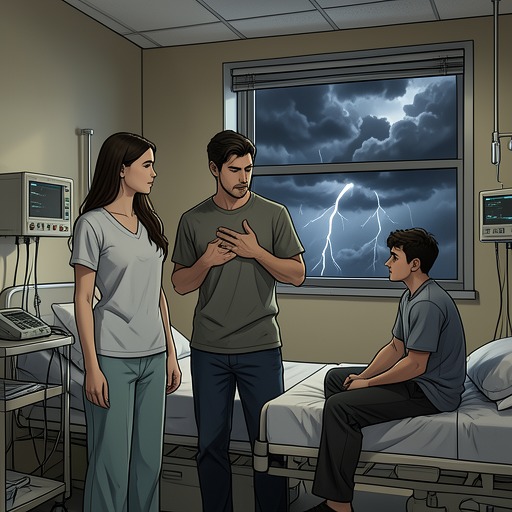
The confirmation broke the tension that had held Stu in place. At home in Tarpon Springs, he hung up, ran outside yelling, and told his sister that the news was good: they had found him. On the way to Tampa General Hospital with Marcia Schuyler and Kristen, Stu received a call from Bill Lally, who was watching footage of Nick being lifted into a helicopter. Even then, Stu asked whether it was really Nick, and Lally assured him that he recognized him.
Relief did not erase the losses of Marquis Cooper and Corey Smith, nor did it resolve the questions that followed the accident. Nick’s later reflections return to the anchor, the lack of distress equipment, the failure to tell others the exact destination, and the absence of readily available life jackets. Stu’s experience gives those practical failures a family dimension: every missing precaution becomes part of the emotional landscape through which he had to wait, imagine the worst, and finally receive the news that his son had survived.